Sunday, May 14, 2006

FAMILY!


It’s always a joy to be with loved ones. This time was no different. As you can probably tell, I’m having a good time with my father and brother and his family in SC. Outside of the obligatory gastronomic celebrations in festive Indian fashion (Thanks, Susan!), we just hung around, took in some sights on S. Carolina’s Atlantic coast, ate out, saw a movie, and generally vegetated (conserving innumerable precious heartbeats in the process, of course).

Article 16 (3) of the Universal Declaration of Human Rights (adopted and proclaimed by the General Assembly of the U.N.) says: The family is the natural and fundamental group unit of society and is entitled to protection by society and the State.

This kindred unit called family is a strange thing, isn’t it? The Bible recognizes the family as special. While proceeding to give his benediction in the middle of the letter to the Ephesians, Paul throws in a cryptic little “aside”…

… the Father [patera],
from whom every family [
patria
]
in heaven and on earth
derives its name ….
Ephesians 3:14

Clearly those key words are similar. But one would suppose that Paul’s interest in the matter was more than etymological. The family, he seems to suggest, has its basis in the Fatherhood of God, and thus in the very concept of the Trinity. The family is special? You bet! And then Jesus radically expanded the boundaries of this earthly kindred, making it even more special in character, when He declared, looking around at His followers …

“For whoever
does the will of God,
he is My brother
and sister and mother.”
Mark 3:35

For those who have taken the first step in doing the will of God by placing their trust in Jesus Christ as their Savior, that momentous step of faith has brought them into a new family relationship. This one is not anthropological, biological, or sociological. This one is spiritual!

For by one Spirit
we were all baptized
into one body ….
1 Corinthians 12:13

The Holy Spirit that indwells every believer is the DNA, so to speak, that links us all in unity. And just as (ideally) we are to go through the experience of life with our biological families, the Bible assumes as a norm that we live our spiritual lives only in communion with our spiritual families, the body of Christ. For instance, that same benediction of Paul in Ephesians 3 exhorts us ….

… to comprehend
with all the saints
what is the breadth and length
and height and depth,
and to know the love of Christ
which surpasses knowledge ….
Ephesians 3:18–19

With all the saints. It might not be too far off to say that a believer cannot experience the love of Christ in its plenitude outside of the family of God, without all the saints. Such an understanding commits us as members of that family to depict to one another the love of Christ in the magnitude of its breadth and length and height and depth! What an overwhelming responsibility we have towards our brothers and sisters in Christ.

Experiencing Christ’s love. Showing Christ’s love. The function of family!

This is His commandment,
that we believe in the name
of His Son Jesus Christ,
and love one another,
just as He commanded us.
1 John 3:23

Bear one another's burdens,

and thereby fulfill
the law of Christ.
Galatians 6:2

So then, while we have opportunity,
let us do good to all people,
and especially to those
who are of the household
of the faith.

Galatians 6:10

Sunday, May 07, 2006

GRADUATION!


It would’ve been nice if the graduation had been mine. But it wasn’t. (I’ll be sure to let y’all know when I’m done with my current educational enterprise.)

One of the daughters of the Morgans (my good friends) was the one who was graduating this weekend in Dallas, going on to attend the U.S. Air Force Academy. And I happened to be the speaker at the ceremony.

A joyous occasion. A moving one. It was a delight to share in the general exhilaration of the moment. Proud parents. Relieved graduates. Elated family. Well-wishing friends. Graduation. Success. Approbation. Reward.

As I enjoyed myself at the celebrations, rejoicing in the triumphs of those students, and partaking in the festivities, I wondered about that most important Graduation Ceremony of life, the last one, the final one, the ONLY one of eternal moment and significance. The day when believers will stand before Jesus Christ, their Savior, for the final accounting of their lives. For those who have placed their trust in Christ for the forgiveness of sin, this is an occasion when the Lord will assess their deeds, not for condemnation, but for the disposition of rewards to believers—our Graduation and the handing out of Honors.

After I gave the commencement address yesterday, I wondered: Will I hear from the Speaker on that Graduation Day to come …

“Well done,
good and faithful slave.
You were faithful with a few things,
I will put you in charge of many things;
enter into the joy of your master.”
Matthew 25:21

Faithfulness in a few things, little things, in what we’ve been allotted in this life, qualifies us for Graduation with Honors. With rewards. What exactly they might be is not very clear. The New Testament also refers to such rewards as “crowns,” which, in 1 Peter 5, for instance, appears to be the prize for an exemplary lifestyle of humility, especially for those who’ve been leaders …

And when the Chief Shepherd appears,
you will receive
the unfading crown of glory.
1 Peter 5:4

The Bible unabashedly touts rewards as incentives to faithfulness in our service to God; of course, rewards are not the only incentives to a godly life, but they certainly are valid ones; Scripture does not shy away from using them to motivate believers to maintain a consistent walk with God.

Run in such a way
that you may win.
Everyone who competes
in the games
exercises self-control in all things.
They then do it
to receive a perishable wreath,
but we an imperishable.
1 Cor 9:24–25

Living faithfully for God, in Christ, by the Spirit. A life in step with His Word, in line with His precepts, in accord with His demands. One way of conducting such a faithful life (training for spiritual athletics?) is, as Paul tells us above, by exercising self-control in all things. Immersed in a culture as we are, bombarded on every side by the slick messages that pander to instant self-gratification, this call for self-control is, to put it mildly, strange!

But not so in God’s view. Self-control now; satisfaction later. Restraint now; rewards later. Discipline now; deserts later. It is a fight to the end, a race to the finish, a fulfillment of obligations, a stewardship of life, for the glory of God!

I have fought the good fight,
I have finished the course,
I have kept the faith;
in the future
there is laid up for me
the crown of righteousness,
which the Lord,
the righteous Judge,
will award to me on that day.
2 Timothy 4:7–8

Let’s get ready for graduation. Summa cum laude!

Saturday, April 29, 2006

MAPS!


Wasn’t difficult. And I did. Many times. Get lost, that is!

Today, I was preaching at Kirkcaldy, close to Edinburgh, about 100 miles south of Aberdeen, at a friend’s church. I decided to drive myself down Sunday morning. My first long road-trip in the U.K.

Therein begins my tale of woe. Unfamiliar road-signs. Bewildering “roundabouts”—sometimes two of them back-to-back! I saw the entire city of Dundee from every possible angle and explored every available street without any clue as to what I was doing and where I was headed. Thankfully, I’d given myself enough time, anticipating this waywardness in my journey!

And I was armed with a map as well; as a matter of fact, I’d several of them, in varying amounts of detail. To top it off, I had printed off directions from Mapquest! All to no avail. I went adrift many a time, meandering from the curved and crooked path into sidetracks and goose-chases after red herrings I should have known better to steer clear of.

It’s not much use having maps and road-signs and directions, if one doesn’t know how to use them. One word comes to mind—“competence.” Competence in reading maps.

However, I’d no trouble returning, for my friend, Dave, gave me a tutorial and coached me on the intricacies of negotiating the whimsical streets of Scotland and their traps for the unwary (read “ignorant”) driver. He was a competent map-reader.

How about The Map of life?

Your word is a lamp to my feet
And a light to my path.

Psalm 119:105

Competence in reading this Map of Scripture is incredibly critical in our journey in life. That’s exactly why there is a science that looks at such competencies—“hermeneutics” (the science—and art!—of interpretation, my current field of interest).

(Incidentally, “hermeneutics” comes from Hermes of Greek mythology, the messenger of the gods, associated with the function of transmuting what was beyond human understanding into a form that is comprehensible. More questionable is this shady character’s standing as the god of rogues, vagabonds, and thieves!)

How do we learn to read The Map of God, His Word, competently?

This competency, like all others, is a function of practice. It is not enough to practice good reading (of the Bible, of commentaries, of Christian books, articles, and magazines). Neither is it enough to practice good listening (to sermons, to lectures, to testimonies). All of those are important in their own way and essential for the body of Christ. But there is one form of practice that should take precedence—the practicing of the Biblical commands and imperatives. Practicing what we already know from the Bible. Practicing what we’ve already read from and about the Bible. Practicing what we’ve already been taught. It’s almost paradoxical: We improve our reading competency as we put into practice what we’ve already learnt.

For everyone who partakes
only of milk
[elementary Biblical doctrine]
is not accustomed
to the word of righteousness,
for he is an infant.
But solid food
is for the mature,
who because of practice
have their senses trained
to discern good and evil.

Hebrews 5:13–14

What did we hear preached from the Word of God at church today? What was the application in the sermon? Let’s determine to practice it. Let’s give our preachers a shock! Let’s practice what we were taught from the Scriptures.

Saturday, April 22, 2006

REUNION!


They’re fun. Reunions. Especially if you haven’t seen the others for a long time. I hadn’t. For over 18 years! The last I saw the Mathews was in India in the late eighties, when they were my neighbors. Almost two decades later, I saw them again last weekend, over Easter, in Sheffield, England.

Reunions! We chatted, laughed, sang old hymns (in English and Malayalam), ate (Indian food, of course!), went sight-seeing, took walks, attended church, listened to Mozart’s Krönungsmesse, discussed theology, talked medical stuff (both husband and wife are physicians) ….

Reunions! Delightful! There is a sense of restoration, akin to finding some part of yourself that was missing all these years. There is the joy of recognizing the growth in Christ, both in your own self and in your reunited compatriots. There is the pleasure in sharing what God is doing in each other’s lives.

But you know what? These are but mere reflections, evanescent shadows, of another grand reunion to be effected in the future, soon and very soon. Loved ones who have gone on before us, saints of all ages, brothers and sisters in the Lord—all physically reunited on that great and glorious day of Christ’s appearing.

For if we believe
that Jesus died and rose again,
even so God
will bring with Him
those who have fallen asleep
in Jesus.
Then we who are alive
and remain will be caught up
together with them in the clouds …

[And, of course, that awesome reunion between Redeemer and redeemed:]

… to meet the Lord in the air,
and so we shall always be
with the Lord.

1 Thessalonians 4:17–18

Always! ALWAYS!! We shall always be with the Lord! This is a perpetual reunion, unceasing, irreversible, eternal!

When we all get to heaven,
What a day of rejoicing that will be!
When we all see Jesus,
We’ll sing and shout the victory!

Eliza Hewitt, 1898

A day of ecstatic rejoicing, exhilarating rapture. A day that will never end! No more parting, no more death, no more grief, no more tears ….

And that’s not all, there appears to be a special reward for those who await that magnificent reunion with their Lord …

… in the future
there is laid up for me
the crown of righteousness,
which the Lord, the righteous Judge,
will award to me on that day;
and not only to me,
but also to all
who have loved His appearing.

2 Timothy 4:8

May we love His appearing, as we eagerly await our Savior and the blessed reunion that is coming. O may these days go by fast. After all we don’t belong here, pilgrims that we are, and bound for another kingdom, existing in another space-time continuum, governed by another constitution, ruled by another King—THE KING—our Savior, Jesus Christ, our Lord!

For our citizenship is in heaven,
from which also
we eagerly wait for a Savior,
the Lord Jesus Christ ....
Philippians 3:20

Even so, Lord Jesus, come! Maranatha!

Sunday, April 16, 2006

SABBATH!


The other day, a good friend, Dan, emailed me a question about the Sabbath that got me thinking about that whole concept ...

Right after the six days of Creation, Genesis 2:2–3 tells us, God sanctified the seventh day when He rested from His creative work (the word Sabbath comes from the Hebrew root that means “to rest, cease, desist”). God had done it all. Not that God had stopped working; He desisted only from His creative endeavors. Jesus affirmed in John 5:17 that the Father still works. Indeed, it is because God is still working—God’s still doing it all—that the Sabbath found its meaning for the Israelites: if He’s still doing it all, they didn’t need to sweat. So on that day, enshrined as a holy day of rest in the Decalogue, the Israelites were prohibited from gathering manna, working, lighting fires, etc., all at the risk of capital punishment. Here’s the rationale, part of the Ten Commandments:

You shall remember
that you were a slave

in the land of Egypt,
and the LORD your God
brought you out of there
by a mighty hand
and by an outstretched arm;
therefore the LORD your God
commanded you
to observe the sabbath day.

Deuteronomy 5:15


Why the Sabbath? Not only had God created, He had also redeemed the Israelites—once again, God had done it all.

There were other Sabbaths for the Israelites—other than the seventh-day Sabbath, that is. The particularly notable ones were, of course, the Sabbatical Year (every seventh year), and the Year of Jubilee (every fiftieth year, after seven rounds of seven years each) (Leviticus 25). In both of these celebratory years, the Israelites were to abstain from agricultural work—the sole means of livelihood and sustenance in their economy—for the entire year (two consecutive years every 49th and 50th year). How would they survive? Yahweh specifically addresses that fear, assuring His people that He would provide during these years (Leviticus 25:20–22): God would do it all.

So what does this mean for the believer today? Simply this: God has done it all. Not just Creation. Not just redemption from Egypt. Not just provision during years of rest. But something bigger, something grander, something … awesome! God’s (re)Creation of the believer in Christ into a new person, unto a new community, under a new covenant, indwelt in an incredibly new way by the Holy Spirit. God’s Redemption of us from the bondage of sin into liberty in Christ, from the kingdom of darkness into His glorious light, from death to life! God's Provision for all our needs (Matt 6:31–32; Eph 1:3) . That’s what we celebrate especially today, the day of our Lord’s Resurrection. For God has, indeed, done it all! (See me enjoying my “Sabbath”?)

Jesus paid it all,
All to him I owe;
Sin had left a crimson stain,
He washed it white as snow.

Elvina Hall, 1865


There can be only one response:

Come, let us worship
and bow down,
Let us kneel before the Lord

our God and Maker.
Psalm 95:6

Therefore the Church—both in the New Testament (Acts 2:4:42; 20:7; 1 Corinthians 16:2) and thereafter—chose Sunday, the day of the Resurrection as the day of worship to commemorate this fact—God has done it all. Let us join the saints of yesteryear and celebrate, not just today, on Easter Sunday, but every day of our lives that blissful and blessed truth. Praise God! He has done it all!

Christ is risen!
He is risen, indeed!

Friday, April 07, 2006

IMAGE!


They say that fools and their money are soon parted. The rest of us wait until income tax time. And it’s almost here. Next week!

(Hey, did you ever notice that if you omit the space “The IRS” reads “Theirs”?)

We’re also in Holy Week, the last week of Lent. Apart from those ecclesiastical lunar cycles and vernal equinoxes that juxtapose tax week and Holy Week, any connection between cash and Crucifixion, possessions and Passion, lucre and Lent?

Lots! There is more than one episode in the Gospels that connects dough with a donkey ride, moola with Maundy Thursday, and loot with the Last Supper.

Indeed, even taxation figures prominently in the accounts of this final week. Soon after Jesus rode into His capital city on Palm Sunday, one of His adversaries asked Him whether the local version of Uncle Sam (His “Divine” Eminence Tiberius Caesar) deserved the Jews’ tribute. “Render unto Caesar the things which are Caesar’s,” was Jesus’s rejoinder, pointing out that the coinage of the realm bore that entity’s image. “And,” He added, “render unto God the things that are God’s”—meaning, evidently, the things that bear God’s image. Now what would that be? Or, rather, who might that be?

God created mankind
in his own image,
in the image of God
He created them,
male and female
He created them.

Genesis 1:27

Thus, Abe’s paraphrase of Mark 12:17: “Fine, give back to that character Caesar these bits of metal he claims are his—these trinkets with his image embossed on them. But, give God everything that carries His image—all of Y’ALL!”

And that’s not all …

At the end of that chapter (Mark 12), Jesus proceeds to show us one who did exactly that—give herself to God. After pointing out that blessed woman to His disciples, He says:

“Truly I say to you,
this poor widow put in more
than all the contributors
to the Temple treasure;
for they all put in out of their surplus,
but she, out of her poverty,
put in all she owned,
all she had to live on.”

Mark 12:43–44


She gave her heart, her soul, her mind, her strength—her everything to God. The tinkling of those two mites tumbling into the coffers of the Temple was the sound of her life being poured out to the Almighty.

He demands it. From you. From me. All of it. All of our lives.

In fact, Jesus had just said so. Quoting from Deuteronomy 6 (Sh'ma Yisrael) …

“And you shall love
the LORD your God
with all your heart,
and with all your soul,
and with all your mind,
and with all your strength.”

Mark 12:30

There’s more …

After a didactic interlude, Mark 13, Jesus returns to this theme. Another anonymous woman (at least in this Gospel). She is “wasting” a gallon of perfume (a TON of $$, a year’s salary) on Jesus. But Jesus’s opinion?

“Truly I say to you,
wherever the gospel is preached
in the whole world,
what this woman has done
will also be spoken of
in memory of her.”

Mark 14:9

And Mark fails to give us her name! She is “everyone”! … Or should be.

Divine-image-bearers that we are, God claims what is rightfully His. Let us, as we approach the end of the season of Lent, resolve to give God His due. All of our selves.

Therefore I exhort you,
brothers and sisters,
by the mercies of God,
to present your bodies
as a sacrifice—
alive, holy, pleasing to God ….

Romans 12:1


Imago Dei. All of us. His. For Him. Pour out.

Sunday, April 02, 2006

SUNSHINE!


I saw it! Indeed, I did! For the first time in six months! The sun. That spectral type G2V yellow star at the center of the Earth’s solar system. I spotted it! That ball of plasma 90 something million miles away from most places on earth; about ten times that distance away from Scotland!

Well, I don’t know what happened or how, but I just happened to catch a glimpse of this elusive planet (see me basking in the effulgence of its radiations!). Last Wednesday. And, for the first time in six months, the temperatures hit a searing 51°F. But, alas, all of this lasted just one single day! Since that glorious morn, the situation has reverted back to the perpetual solar eclipse that prevails in these parts. The chariot of Helios has gone into hiding again. And mercury has dipped: they say it will snow tomorrow!

Oh, Spring, where art thou?

Not an easy task to echo the sentiments of Elizabeth Clephane penned in 1872 …

I take, O cross, thy shadow
For my abiding-place:
I ask no other sunshine than
The sunshine of his face;
Content to let the world go by,
To know no gain nor loss;
My sinful self my only shame,
My glory, all the cross.

No other sunshine? I need that kind of contentment! But truly, His is the only Sunshine that will never be eclipsed, obscured, or otherwise dimmed. His is the only Sunshine that can thaw cold hearts, enliven dormant souls, rejuvenate captives in the dark and dreadful dungeons of sin. The heavenly lights? They won’t shine long (Isaiah 13:10). The celestial hosts? They wither away (Isaiah 34:4).

Jesus shines brighter, Jesus shines purer
Than all the angels heav'n can boast.
Joseph Seiss, 1873

And in the new creation, at the end of time, it seems that the grand new city, the New Jerusalem, might not even have any more light-generating bodies in the sky for …

… the city has no need
of the sun or of the moon
to shine on it,
for the glory of God
has illumined it,
and its lamp is the Lamb.

Revelation 21:23

No life without the sun, we’ve been taught. But in God’s economy, there is no life without the Son. The Son who gave Himself for us and for our sin, accomplishing our redemption through His work on the cross. So it is appropriate in these last weeks of Lent to reflect upon a Lutheran Easter hymn (Christ lag in Todesbanden, which has also been wonderfully wrought into a cantata by Bach—BWV 4) that enjoins believers to celebrate the Feast of the Resurrection.

Therefore let us keep the Feast
With heartfelt exultation;
The Lord to shine on us is pleased,
The Sun of our salvation.
On our hearts, with heavenly grace,
Beams the brightness of his face,
And the night of sin has vanished.
Hallelujah!
Martin Luther, 1524

Hallelujah, indeed! Hail, the Sun of Righteousness! Jubilate! Fling wide the gates for the Savior.

Light of the world,
You stepped down into darkness …
Humbly You came
To the earth You created
All for our sake …
So here I am to worship …

Tim Hughes, 2000

Let’s take time in the next two weeks to attend especially to worshipping God for having brought us out of the kingdom of darkness into His marvelous light. For opening our eyes and letting us see ….

Sun of my soul, thou Savior dear,
It is not night if thou be near;
O may no earth-born cloud arise
To hide thee from thy servant's eyes.
John Keble, 1820

Sunday, March 26, 2006

FEAST!


I got a threatening letter last week.

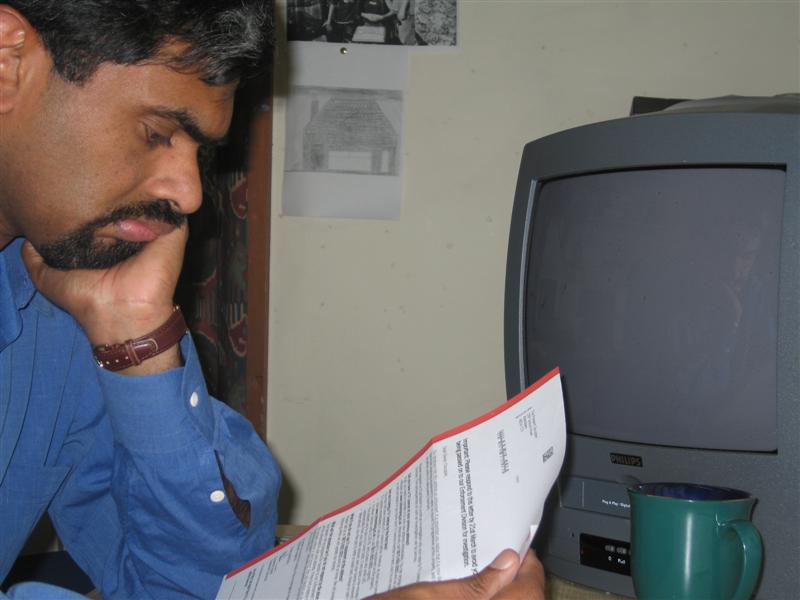
“Please respond to this letter by 21st March to avoid your details being passed on to our Enforcement Division for investigation” it said. They wanted to extract £130 (about $200+) out of me. “They” meaning The TV Licensing Board of the United Kingdom.

What in the world did they want with me, I wondered.

Oh, and “in accordance with Police and Criminal Evidence Act 1984” I could be risking a £1,000 (about $1600+) fine if my transgression and felonious malfeasance continued unabated!

Some kind of joke? It looked authentic. There was a phone number. I called.

The scoop: The only TV channels one gets in the U.K., if one doesn’t have cable or other such devices, are BBC 1, BBC 2, BBC 3 … (about four or five such, I am told). The thing about BBC—it is commercial free. So everyone pays a licensing fee. Hence the screw being tightened on yours faithfully in an attempt to extort some pounds sterling out of this starving student (subsisting entirely on imported JIF!).

I confess there is a TV on the premises—I live in a furnished flat, which comes with everything (linens, cookware, and … a TV). But beyond turning it on to see if it worked when I moved in 6 months ago, I have not watched TV at all; neither do I intend to in the future.

The folks I talked to accepted my excuse; however, they are going to send an “inspector” to visit me! (I’ll let you all know if I need to be bailed out of jail or something!)

I have nothing against TVs. I never used to watch it in the U.S. either. Many years ago—a totally personal resolution—I decided to exercise some serious caution on what went in through the eye-gates of my soul. One of those vigilante measures included passing up on TV. (Of course, not having time to sit before the box helped as well.)

This is not to say there aren’t other ways I could get into trouble with my eyes. I do have internet. But the presence of a “history folder” that maintains a log of every site I visit keeps me accountable.

It’s an ongoing battle. And it’s something we all struggle with, I’m sure: What enters our souls? What are we to keep thinking about? What must we be feasting our minds upon?

Good things. Godly things.

Finally, brethren, whatever is true,
whatever is honorable, whatever is right,
whatever is pure, whatever is lovely,
whatever is of good repute,
if there is any excellence
and if anything worthy of praise,
dwell on these things.

Philippians 4:8

God’s truth is everywhere, certainly, even in secular material (and on TV, I’m sure). All truth is God’s truth. He owns truth. He has a monopoly on it. He is Truth!

But the example nonpareil of truth is the Scriptures. Unadulterated. Unfailing. Unparallelled. Trustworthy. Tried. Tested. TRUTH!

How blessed is the one
who does not walk
in the counsel of the wicked,
Nor stand in the path of sinners,
Nor sit in the seat of scoffers!
But his delight
is in the law of the LORD,
And in His law
he meditates day and night.

Psalm 1:1–2

Let’s keep on reading it. Dwelling upon it. Meditating in it. Treasuring it.

Your word I have treasured
in my heart,
That I may not sin
against You.

Psalm 119:11

In these Lenten days, let’s go for a feast, shall we? Of Scripture. Undertake to dig in. Do a bit more than usual. If it’s not a habit, make it one.

Engorge! It's sweeter than honey (Psalm 19:10) ... and its fat free!

Sunday, March 19, 2006

GOOD?


Friday: I ate a slice of pineapple. Big deal, you say. Yes, BIG DEAL, I reply. You see, I used to be allergic to that species of fruit as a child. And over the years, I had gotten over the allergy … or so I thought! Two days ago, I decided to go for a piece of that plant product after a nice dinner at a fellow-student’s. Bad choice! I will spare you the embarrassing and morbid physiological details. Suffice it to say, a few hours later, I was confined to a certain room in my flat. For a long time. In several spells.

I thought it would be fine, but it wasn’t.

Saturday: Mark (another “Dawg”) and his wife, Dawn, and I took a trip to the outskirts of Aberdeen looking for good food! We found it in lush Victorian settings at a place called Tor-na-coille (Gaelic for something like “house among the trees on the hilltop”). Brave soul that I am, I ordered—for the first time in my life—haggis. For you of non-Scottish inclinations and proclivities, here’s how the recipe for this gastronomic delicacy starts: “Take the heart, lungs, liver and kidneys of a sheep, chop them up, add suet, onions, oatmeal, cayenne pepper and other seasonings, stuff all of that into the stomach of a sheep and boil it for 2 hours.” Nice, huh?

Yup! That’s what I ate. I know what you are thinking. One evocative and emotive word: Yuk!

But I have to confess, folks, it tasted pretty good! (And, for those concerned about the subsequent state of my intestines—they’re still discharging [ahem!] their responsibilities quite well, thank you!). So much so, I might actually go for it again! Haggismaniac, you can call me henceforth!

I thought it would be horrid, but it wasn’t.

What I figured I’d like, I didn’t! What I expected to hate, I liked! Strange! I don’t know what’s good for myself … and it seems like I don’t know what’s bad for me either.

On the other hand, maybe not so strange.

For I know that nothing good dwells in me,
that is, in my flesh ….

Romans 7:18

I am easily fooled by my own prejudices, my own sins, my own depravity. I don’t know what I should be doing, and what I should not; what is good for me and what is not! I don’t! You don’t! Nobody does! But God!

When 1 Thessalonians 5:21 urges us to “hold fast to that which is good,” it presumes upon the truth of these Paul’s words to Timothy:

All Scripture is inspired by God
and profitable …
so that the [wo]man of God
may be adequate,
equipped for every good work.
2 Timothy 3:16–17

What is good for us is what God decides. His will.

And do not be conformed to this world,
but be transformed
by the renewing of your mind,
so that you may prove
what the will of God is,
that which is good
and acceptable and perfect.

Romans 12:2

And God’s will is sufficiently portrayed for us in His Word. Let us learn therefrom to “love what is good” (Titus 1:8). Pausing for a moment as we journey towards Holy Week, let us recommit ourselves to the Scriptures, to study it and to practice it.

But solid food is for the mature,
who because of practice
have their senses trained
to discern good and evil.

Hebrews 5:14

Haggis, anyone?

Sunday, March 12, 2006

EXCHANGE!


There is a ritual I go through before and after my trips to the U.S. from the U.K. Wallet-switching! I don’t carry a lot of cash with me, but what little I do is mismatched in size. The British pound notes are wider and shorter than the American dollar bills. Simply for that reason alone I use separate wallets in each country.

Moreover, I have no use for my University of Aberdeen ID card in Texas and neither do I need my DTS ID in Scotland. Those copy-machine cards I use here won’t function there, and the DTS and SMU copy-cards are unrecognizable at the U of A. My U.S. medical licenses are inconsequential here in the U.K. And so on ….

All of this mandates a ceremonial exchange of material from one pocket receptacle to another as I make the Atlantic passage back and forth between different worlds. Different requirements. Different laws. Different systems.

Jesus once said: “My kingdom is not of this world” (John 18:36). Different dimension. Different time. Different space. And those of us who believe in Him are already citizens of that different kingdom.

For He rescued us
from the domain of darkness,
and transferred us
to the kingdom of His beloved Son ….

Colossians 1:13

Calls for an exchange, doesn’t it? Different kingdoms. Different King. Different priorities.

As we continue our pilgrimage through Lent, reflecting upon the redemption Christ achieved for us—our exchange from one kingdom to another—let us, in turn, ponder upon exchanges we can commit to, as we seek first His kingdom.

Do not love the world
nor the things in the world.
If anyone loves the world,
the love of the Father is not in him.
For all that is in the world,
the lust of the flesh and the lust of the eyes
and the boastful pride of life,
is not from the Father, but is from the world.

1 John 2:15–16

The world we live in is so unlike the kingdom we’re part of that the exchanges we can (and must) make are diverse and myriad. But all this talk of wallets reminds me of one thing, though. Money. What currency should I hang on to? What coinage? And of which realm?

Ringing gold is hard to relinquish. Lucre is hard to leave. Mammon bids us mutiny against heaven. But you know what?

For we have brought nothing into the world,
so we cannot take anything out of it either.

1 Timothy 6:7


Nothing. NOTHING! “Life is but a pilgrimage from one point of nakedness to another.” This life certainly is. But we can prepare to be clothed in glory in the next life by exchanging our earthly funds and saving in the vaults of heaven.

But store up for yourselves
treasures in heaven,
where neither moth nor rust destroys,
and where thieves do not break in or steal;
for where your treasure is,
there your heart will be also.

Matthew 6:19–21

Where is my heart? Here? Then I must exchange! And my treasure? In this world? Exchange!

How can we begin to exchange “treasure”?

Tax time, folks, is just around the corner. We know how much we gave to the Lord’s work in 2005. Let’s seriously consider increasing our giving in 2006 and let’s plan accordingly.

Let’s ensure our treasure (and our hearts) are in the right place. Then, and only then, can we pray sincerely …

Thy kingdom come. Thy will be done,
On earth as it is in heaven.

Matthew 6:10

Sunday, March 05, 2006

EXAMINATION!


It snowed … and snowed … and snowed. So much so, the plane I was to travel on from Aberdeen to London last week was delayed coming in and delayed going out. I was pretty sure I’d miss my flight from London to Dallas.

About two hours late, I finally land at Gatwick. For some reason, we taxi to the international terminal to park at gate 61 in the North Terminal … right next to gate 63 and a shiny, silver 777 flying machine with the letters “AA” emblazoned in blue and red—my plane to Dallas, American Airlines flight 79.

We get to the gate, the pilot turns off the seat-belt sign and, as if on cue, and to my immense chagrin, AA 79 begins pulling out of gate 63. My nose is glued to the window, as I dejectedly watch the aircraft leave. That’s my plane! So near and, yet, so far!

Because we had arrived at the international terminal, they had to bus the passengers to the domestic end of things. To make matters worse, our bus kept shadowing AA 79 on the tarmac for the next several minutes. I couldn’t bear to look. That is (correction: “was”) my plane! So near and, yet, so far!

The long and short of it was that because I was a few minutes late, I had to spend the next 20 hours in a London hotel (I did get to see part of the England v. India first cricket Test on cable, though!). So near and, yet, so far!

That happens far too often in the spiritual life. For those of us who are believers, of course we will not miss heaven, secure as we are in the redemptive work of our Lord Jesus Christ. But there is something we might miss out on—and usually not by far … rewards in heaven. So near and, yet, so far.

Especially in this Lenten season, periodic self-examination is called for, to make sure we are on the pathway to moral excellence in the power of God's Spirit; this kind of introspection is quite a pervasive theme in the New Testament.

… each one must examine one’s own work ….
Galatians 6:4

… so that the [examination] of your faith,
being more precious
than gold which is perishable,
even though [examined] by fire,
may be found to result in praise
and glory and honor
at the revelation of Jesus Christ ....
1 Peter 1:7

Let’s pay especial attention to our communal partaking of the Lord’s Supper, utilizing that dominical ordinance as an opportunity to examine ourselves, and of course, taking steps to correct our courses as necessary.

But one must examine oneself,

and in so doing one is to eat
of the bread and drink of the cup.
1 Corinthians 11:28


… [
examining] what is pleasing to the Lord.
Ephesians 5:10

The goal of that self-examination? To live as He would have us live. To qualify for His rewards. To hear His words, “Well done, good and faithful servant.” To please God. To excel for His glory.

Finally then, brethren,
we request and exhort you
in the Lord Jesus,
… that you excel still more.
1 Thessalonians 4:1

Now for this very reason also,
applying all diligence,
in your faith supply moral excellence,
and in moral excellence, knowledge,
and in knowledge, self-control,
and in self-control, perseverance,
and in perseverance, godliness,
and in godliness, brotherly kindness,
and in brotherly kindness, love.
For if these qualities are yours
and are increasing,
they render you neither
useless nor unfruitful
in the true knowledge
of our Lord Jesus Christ.
2 Peter 1:5–8


Sunday, February 26, 2006

DISCIPLINE!


I am not for it! At least not the physical kind of discipline. I have no intention of rapidly running through my finite allotment of heartbeats, in typical Esau fashion despising my birthright and greedily devouring my ration of systoles and diastoles. If you want to speed things up a bit, by all means, go ahead. No tachycardia for me!

[Something wrong with my theology here?]

Anyhow…

This, folks, is a special week in the church calendar—that cycle of events that keep time in the life of the Body of Christ. This is a special week because this Wednesday is Ash Wednesday, which marks the beginning of Lent.

In the church, Lent (from the Old English word for spring) has come to demarcate the 40 days, excluding Sundays, that lead up to the greatest event on the church calendar, the event because of which the church exists—the Resurrection.

Lent serves as a preparation for this glorious redemptive event and, traditionally, the community of God’s people has prepared for its celebration with an examination of why, in the first place, redemption was necessary. The church through the ages (indeed, Lent was discussed in the Church Council at Nicæa, in 325) has utilized Lent for self-examination—a probing scrutiny of the sinful human condition and its deadly consequences for individual and society, and an equally intense consideration of the new life offered to us in Jesus Christ.

Discipline has been the key word of the Lenten season—intentional and sustained acts of self-control, not proceeding from a sense of duty or obligation, but from a heart of grateful devotion to God and Christ.

… discipline yourself
for the purpose of godliness;
for bodily discipline is only of little profit,
but godliness is profitable for all things,
since it holds promise for the present life
and also for the life to come.

1 Timothy 4:7–9
Think of the disciplines as ways we can place ourselves in the path of God’s sanctifying grace. Like placing your hands under a faucet: it is the water that cleans, but you’ve got to place your hands in the stream of water. Spiritual disciplines are to spirituality and godliness what a training regimen is to an athlete.

If any man will come after me,
let him deny himself,
and take up his cross daily,
and follow me.


Luke 9:23
There are things we can do and/or things we can give up (temporarily or permanently) in the denial of ourselves for the sake of following Christ, for the sake of developing godliness. Dallas Willard (The Spirit of the Disciplines) calls them the disciplines of engagement: worship, fellowship, study, prayer, service, etc.; and the disciplines of abstinence: solitude, silence, celibacy, simplicity, fasting, etc.

Consider engaging in one or more this somber season of Lent. Hopefully this disciplinary exercise will become a habit that transcends the span of 6+ weeks. I sure hope it will with the discipline of engagement I’ve resolved to undertake: regular memorization of Scripture. Anyone care to join me in this enterprise of treasuring God’s Word in our hearts (salvaging a few cardiac impulses in the process)? At least those Bible verses on this blog weekly?

Or you could consider one or more of these practices: skipping a meal or a favorite food? scheduling more time for prayer or Bible study? giving of your self and your resources in service of our fellowmen? … ?

Discipline. For the purpose of godliness. For the profit it holds for this life. For the profit it holds for the life to come. For the glory of God!

…discipline yourself
for the purpose of godliness …

Sunday, February 19, 2006

POWER!


This blog will be rather disjointed—a collation of reports from my various homiletical exertions this weekend.

9:00 pm on Saturday, February 18
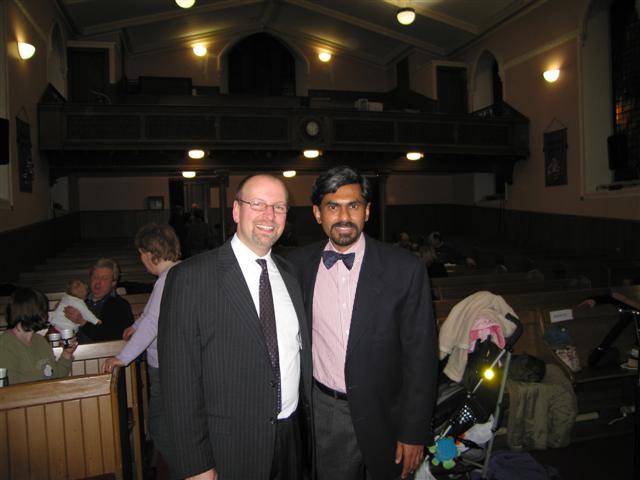
Just got back from Kirkcaldy, a town just north of Edinburgh and a two-hour drive from Aberdeen, after preaching at a friend’s induction as pastor of a Baptist church (that's David and I in the picture). An enjoyable experience. Real friendly folks. Very appreciative of my efforts. Lots of food (with the exhilarating option of dousing all the desserts in “double cream”—a more calorific version of heavy cream; I took the option … and all the desserts).

1:00 pm on Sunday, February 19
Morning service at High Church Hilton (Church of Scotland) went very well. God was gracious!

First time I’m preaching in a service with a pipe-organ in employment. However, just as I embark upon my opening illustration, the organist drops a book or something on the manuals, setting off a disconcerting musical squawk! However, it came at a perfect point in the story, so I was able to weave that “noisome pestilence” right into it! The things preachers have to do!

5:00 pm on Sunday, February 19
Preached at a Chinese congregation. They sang in both English and Cantonese … at the same time! One gets a feel for what Pentecost must have sounded like (and what heaven might, too). And having a translator was a different experience; it does give you time to think on your feet, and tweak things even as you go along.

One more service to preach ….

9:00 pm on Sunday, February 19
The relaxed (no bow-tie!) evening service at High Church gave me a few more precious minutes to preach than I had in the morning (30 min. vs. 25 min.). People tended to hang around after this service over tea and biscuits (i.e., cookies); that was a delightful time to meet folks.

Well, I’m done … for now! A most enjoyable week for me (and hopefully for my hearers as well). Thanks to all those who held me up in prayer in response to last week’s aBeLOG. And, by God’s grace, I’m none the worse for these exertions of preaching—neither particularly fatigued nor strained. I’m well aware that were it not for the Holy Spirit’s strengthening, none of this would have been physically possible. Paul would agree about the indispensability of God’s empowerment …

For this purpose also I labor,
striving according to His power,
which mightily works within me.


Colossians 1:29
Preaching, as I taught in my seminar last week, is doxological in goal: to change lives for the glory of God. The preacher is just one cog in that complex process by which God is molding all of us by His Spirit into Christlikeness. The cog, therefore, functions contingently upon the sovereign designs and agency of God the Spirit. Ministry cogs that we all are in some form or another, we are (and we must be) utterly dependent upon the Third Person of the Trinity, if we are to achieve our doxological aims. Needless to say, the power of God is available to all believers—not just preachers. In every ministry activity we engage in, may we do so relying upon God, by whose power alone we can do all things. And may God be glorified by it all.

Now to Him who is able to do
far more abundantly
beyond all that we ask or think,
according to the power
that works within us,
to Him be the glory
in the church and in Christ Jesus
to all generations
forever and ever. Amen.


Ephesians 3:20–21

Sunday, February 12, 2006

PROCLAMATION!


It’s been a long time. And I miss it. The last time I occupied a pulpit was about six months ago at my ordination in Plano Bible Chapel, TX (see picture).

Engaged as I have been in exploring preaching here in a foreign land, opportunities for undertaking the other two facets of the triad of my life (!)—explaining preaching and exemplifying preaching—have been few and far between; in fact, they have been non-existent. Until now.

Between this writing and the next (Deo volente, next Sunday), I am scheduled to be preaching four times and conducting a 3-hour “teaching of preaching” session.
  • WEDNESDAY: Speaking God’s Words (a preaching seminar for about ten postgraduate students from the University of Aberdeen; organized by the church I attend).
  • SATURDAY: Preaching at a Baptist church in Kirkcaldy (near Edinburgh) that is inducting its new pastor, a friend of mine (and a DTS alumnus).
  • SUNDAY: Preaching in the morning and evening services at my church (High Church Hilton, Church of Scotland)—two different sermons; and also in the afternoon service of the Chinese congregation there.

God has been gracious in providing me these occasions to involve myself in the exercise of what might be my spiritual gifts. And I’m excited to be doing so, for that’s what I’m most passionate about.

We proclaim Him,
admonishing every man
and teaching every man
with all wisdom,
so that we may present
every man complete in Christ.

Colossians 1:28

May I utilize this public venue to request prayer for preparation that is adequate, for protection from the wiles of Satan, for passionate delivery, and, above all, for the power of the Holy Spirit to be manifest in me and in my hearers as I engage in the ministry of the Word? May God be glorified in Christ through the Spirit.

Spiritual gift or no, we are all called to be proclaimers. In season and out of season. To those who believe and to those who don’t. In word and in deed.

In a sense, whether we acknowledge it or not, we are always proclaiming—proclaiming something! The question is what!

But you are a chosen race,
A royal priesthood, A holy nation,
A people for God's own possession,
so that you may proclaim
the excellencies of Him
who has called you
out of darkness
into His marvelous light.

1 Peter 2:9
The Great Commission! For all of us to undertake. Let us take to heart the exhortation of the author of Hebrews (5:12): “… by this time you ought to be teachers.”

Proclaiming the excellencies of a living God is not easy: it was hard then, it is hard now. Let us take some small steps towards getting into the habit of proclaiming God, so that we become skillful in proclaiming God, so that we develop a character that, as a matter of course, continues in proclaiming God. A suggestion for starters (that I, too, intend to carry out): As naturally as we can, let us try to introduce the word “God” into our conversations. Eugene Peterson called it “centering”—locating God in the center of everything. A brief mention. A quick nod in His direction. A slipping in of His name. “God.” And perhaps those small beginnings will lead to bigger and better things.

Proclamation! May He employ us all in that glorious task!

Sunday, February 05, 2006

HEALING!


It was a tremendous delight and privilege to don on my white jacket again this week, as I returned—temporarily—to my vocation as a dermatologist. Not only was it a joy to see the friendly faces of the clinic staff, it was a pleasure to see patients, both familiar and new, and to get back into the absorbing and challenging task of diagnosis and therapeutics, the art and the science of medicine (their “rhetoric” and their “logic”?).

The schedules were full. Lots of patients. Lots of work. All the days I was there. I would love to think that everyone of those folks were successfully treated and relieved of all of their ailments. But the limits of my knowledge and the awareness of my finitude inform me otherwise. That’s why the unparalleled recurrences of those incidents in Matthew’s Gospel were remarkable as I read them this week.

They are striking! Aside of Jesus’ healings (therapeuo in Greek) of specific individuals from their specific afflictions, Matthew sprinkles his record with intimations of the Lord having healed everyone who came to Him (in chapters 4, 8, 12, 14, 15, 19, and 21). Everyone. All were healed. Of all their physical complaints. And several of those texts make an explicit connection between Jesus’ curative campaigns and His compassion (Matthew 14:14, for instance).

Also interesting is that therapeuo does not occur outside of the Gospels and Acts (and twice in Revelation). Whatever that signifies, medical personnel, to this day, continue that noble and divine tradition of attempting to give relief to their patients and fellowmen.

Relief! Comfort! Consolation! Rest! That’s what everyone seeks. For body and mind. No one, most certainly, is going to find that absolute and totality of ultimate relief and comfort this side of heaven. For body or mind.

And not all of us, of course, are licensed to dispense medication or perform surgery to alleviate the tangible indispositions of our fellows.

But one thing we can do—all of us. We can be a “refreshment” to one another in the community of God. Even the apostle Paul sought such relief from Philemon. He exhorts:

Yes, brother,
let me benefit from you
in the Lord.
Refresh my heart in Christ.

A “refreshment” in Christ, to another. What a marvelous picture!
Bringing Christ’s compassion to each other. Being a conduit of His love.
His hand. His heart.

Therapeuo may not occur in the Epistles, but parakaleo certainly does. “To comfort.”

Blessed be the God and Father
of our Lord Jesus Christ,
the Father of mercies and
God of all comfort,
who comforts us in all our affliction
so that we will be able to comfort those
who are in any affliction
with the comfort with which
we ourselves are comforted by God.

2 Corinthians 1:3–4

A refreshment. A relief. A comfort.
A helping hand. A supporting shoulder. A praying heart.
Compassion. Kindness. Generosity.
Warmth. Smiles. Love.

A refreshment, indeed. May we be so to those around us. For everyone. Always!

Sunday, January 29, 2006

COMMUNITY!


On the front it said “University of Aberdeen.” On the back, “Will Preach for Food”! That’s the T-shirt that these dear folks gave me last Christmas. (In addition to JIF, that is!). I loved it!

(I can imagine wearing that whimsical garment to one of my meetings with Prof. Watson. He probably wouldn’t say anything; at most, a single scandalized eyebrow might raise itself in typical British disdain!)

That epigram on that piece of apparel was the brainchild of the people of Lake Pointe Church, in Rockwall, TX, specifically the Saturday evening Adult Bible Fellowship (pictured), led by Timothy Warren (my teacher, colleague, friend, and brother in Christ).

This weekend, it was a delight and a privilege to see this group and the Sunday morning ABF as well (both under Dr. Warren’s leadership).

Faithful in prayer, generous in support, diligent in emailing, solicitous in concern, affectionate in heart, … this particular community of God’s people has been a blessing to me the last several years—both when I’ve been in town and now when I’m not.

Indeed, God’s people that I’ve had the privilege to know and love in the past couple of decades have always been faithful, generous, diligent, solicitous, affectionate ….

Allow me to name them individually:
  • Faith Bible E-Free Church (TX)
  • Houston Int'l Christian Fellowship (TX)
  • Watertown Evangelical Church (MA)
  • Plano Bible Chapel (TX)
  • Sherman Bible Church (TX) and
  • Lake Pointe Church (TX)

I have been richly blessed by God through these saints in communities where 1 John 4:12 is fleshed out daily.

If we love one another,
God abides in us,
And His love is perfected in us.


No wonder the letter to the Hebrews exhorts believers not to forsake assembling together, for this is where love is seen, felt, touched, and demonstrated.

Let us consider
how to stimulate one another
to love and good deeds,
not forsaking

our own assembling together ….

Hebrews 10:24–25

There can be no Christianity without Christian community. Indeed, a “solitary Christian” is a concept foreign to the Scriptures, perhaps even an oxymoron. On a personal note, I remind myself often that the kind of singleness that I “espouse” is not the ascetic, eremitic sort—secluded and insular. I want to be “single in community,” embedded in, working for, and sustained by the people along with whom I call God, Father. Where would I be without the body of Christ? What would I do without the gifts of the Spirit that minister to me?

The call of God to love one another in community is serious business, displaying as it does, God’s own love for us. Self-negating love. Other-centering love. A ready-to-die kind of love. And He requires that of us as well ….

We know love by this,
that He laid down His life for us;
and we ought to lay down
our lives for the brethren.


1 John 3:16

May God give us the grace to do so. To work hard at loving. To love with abandon. To love sacrificially. To love as God loved us. To love till we die!

For God so loved the world ….

Sunday, January 22, 2006

ANTICIPATION!


I had figured I’d be pretty despondent when I returned. After more than two weeks away, I thought I’d dread coming back. It would be depressing, I expected. The end of Christmas and New Year celebrations. Away from family and friends. Far from (what still technically is) “home.” No more sunshine! No more basking in the 70s! I predicted a dispiriting and disheartening flight back to Aberdeen earlier this month. But I was wrong.

There was an ebullience in my heart and all my 158 lbs were borne with a lightness of step, lofted by a blithe spirit, giddied by an anticipating mind.

Anticipation? Indeed!

Anticipation brought about by good news! I would be heading back to the U.S. just about three weeks after I returned to Scotland post-Christmas: my erstwhile dermatology associate wanted me to fill in for him in Dallas for the week straddling the last days of January and the early part of February. So I would be going home … again … soon. And I am! This week!

(Talk about a long commute to work: 10,000 miles RT!)

The anticipation of that upcoming trip, made these last 3+ weeks hurtle by in quadruple time! I was going home! The ardent expectation of that trip made those December goodbyes in Dallas easy and these days in Aberdeen transitory. That’s what “going home” can do for you!

Well might the sun in darkness hide
And shut his glories in.
Dreary skies? Phooey! I couldn’t care less. I was going home. Where …

Fair is the sunshine, fairer still the moonlight!
Yup! That’s Texas, y'all!

It’s pouring outside. And I …

I'm singing in the rain; Just singing in the rain;
I'm laughing at clouds So dark up above
The sun's in my heart And I'm ready for love.
(Well, maybe not that last part!)

But you get the picture: I’m headed home!

Praise Him, ye stormy winds that blow,
Ye fire and hail, ye rain and snow.
Fine with me. The Scots can keep all of it—storm, wind, fire, hail, rain, and snow.

Sun and moon, rejoice before him;
Praise Him, all ye stars and light.
Now we Texans can handle that!

Then I began to think …

If a brief one-week trip can do this to me—make me lighthearted, blithe, and giddy—I wondered what the anticipation of an eternity in heaven could do to lighten up my (few and thankfully brief) days here on earth? Am I that wistful and wishful about my real Home? Am I equally enthusastic and exuberantly passionate about heaven? Am I waiting eagerly?


For I consider that
the sufferings of this present time
are not worthy to be compared
with the glory
that is to be revealed to us.
For the anxious longing of the creation
waits eagerly
for the revealing of the sons of God.
Romans 8:19

… even we ourselves groan within ourselves,
waiting eagerly
for our adoption as sons,
the redemption of our body.
Romans 8:23

… if we hope for what we do not see,
with perseverance
we
wait eagerly for it.
Romans 8:25


RESOLVED: To think about and anticipate—wait eagerly for—heaven at least once a day, every day! After all, I’m going Home! I ain’t got long to stay here!

Sunday, January 15, 2006

AUTHORITY!


For the last four months or so, as you can see, I have been engaged in the leisurely labor of crafting a thesis. I expect this tranquil toil to continue for a while, before I’m done with the gratifying grind. Oh, the delight of this drudgery!

Prof. Watson and I are getting along quite well together, I might add. We’ve been meeting almost weekly. I tell him what I’m thinking. We discuss what I’ve submitted. He gives me his input.

Looking back on those meetings with my supervisor, I detect an interesting (and edifying) pattern. At least half a dozen times, if not more, Watson suggested scholars whose work, he felt, would be helpful for me to examine. And every single time, all of those half a dozen times, I thought he was barking up the wrong tree! I didn’t care much for what, I concluded, were tangential trajectories of exploration. I distinctly remember coming away from those meetings in despair!

Wittgenstein? Ricoeur? Explore their notions of “language games”? “genre”? What have those dead philosophers and their dry prescriptions got to do with what I want to do? Thus I thought, but, open my mouth, I did not. Like Mary of old, I pondered them in my heart.

Actually, I did better: I went to the library to make my case. You can guess what happened next, can’t you?

Three cheers for that good ole’ deutscher thinker, Ludwig Wittgenstein (1889–1951), and that homme français, Paul Ricoeur (1913–2005), who have since become my best buddies. I’ve practically devoured everything they’ve written. And “language games” and “genre” feature preeminently in my work, needless to say.

There is a lesson in this, I think.

Hear, my son, your father’s instruction,
And do not forsake your mother’s teaching;
Indeed, they are a graceful wreath
to your head,
And ornaments about your neck.
Proverbs 1:8

Simply put, I must listen to those in authority over me. No, not to give them carte blanche, of course, but the proverb does convey a truth that is more often right than wrong. Exceptions? Sure. But for the most part the wisdom of this text holds good.

And what if those in authority are wrong?

Remember that French dude, Ricoeur, that I mentioned? Prof. Watson originally wanted me to pursue him for one particular reason. That reason unraveled to become nothing but a totally false lead. But, quite gratuitously, while investigating Ricoeur’s prodigious and near-encyclopedic output, I hit upon a vein of pure gold that turned out to be extremely useful; it might well end up being the linchpin of my thesis.

Lesson? God can use even false leads to bless me. He can even use mistakes by authorities to pour it on. Abundantly. Beyond measure. If … I am willing to submit. I hate to think of what I’d have missed, had I not taken Prof. W seriously.

And we know that God causes
all things to work together
for good to those who love God ….
Romans 8:28

That’s it. I’m done. Henceforth, I quit rebelling. (At least, that’s my resolution for 2006!) And I begin trusting. In Watson, sure, but that’s because I’m trusting—even more—my God! Sovereign. Loving. Gracious. Merciful. And good!

Sunday, January 08, 2006

DARKNESS!


Yup! It’s dark. That’s why you can’t see much in the picture. The sun has set. Night has fallen. And it’s only 3:30 pm! That’s what happens when you live 57°North of the equator, a paltry 9°below the Arctic Circle! Add to this the perpetually overcast skies, and you have a pretty bleak midwinter day to be ecstatic about!

Life. Darkness and light. Night and day. Pain and pleasure. Bane and blessing.

The truth is that we are going to experience darkness of one sort or another, of one intensity or another, before this life is over. The question is not whether darkness will envelop us; the question is when it will. Pleasure, one said, is but an intermission in the sequence of pain. Some of you might actually be in the valley of shadow of death even as you read this. For others, 2006 may be the harbinger of tears, the valet of pain, the emissary of grief. It’s only a matter of time. Life is messy!

Flee these morbid thoughts, you say. But I say, better to be prepared. How? How can we be ready to face those trials, tumults, turmoils that life is sure to cast in our paths?

Hopefully, the worst is over for us Aberdonians suffering the disappearance of that bright orb of fire in the sky these wintry days. The longest night of the year is behind us. This darkness shall pass. My confidence is grounded in the sure knowledge that, beyond the darkness, there is a sun. Indeed!

And you know what? Beyond our life-is-messy-darknesses, as well, there is a Sun—this One, however, is the Sun of righteousness, packing energy Spiritual, not solar.

Light and life to all He brings,
Ris’n with healing in His wings.

Charles Wesley, 1739, from Malachi 4:2

This is the Son, who for the joy set before Him endured the cross (Hebrews 12:2). He went through darkness, so that you and I wouldn’t have to live in it forever, so that we wouldn’t be beset by an eternity of wintry nights, unrelenting pain, unflagging grief, haunting bane. This was the joy He pursued—to save us, to redeem us, to rescue us. This was His joy—His love for you, for me!

Therefore, there is an end to the darkness. This darkness, too, shall pass. The Sun will rise. In fact, He is risen! And one day, darkness will fade away permanently: there shall no longer be any night, neither will there be a need for the light of the sun, because the Lord God shall illumine them—His people, the saints of God, you, and me (Revelation 22:5).

Life—hallelujah!—will no longer be messy!

For momentary, light affliction
is producing for us
an eternal weight of glory
far beyond all comparison,
while we look not at the things which are seen,
but at the things which are not seen;
for the things which are seen are temporal,
but the things which are not seen are eternal.

2 Corinthians 4:17–18

Keep your eyes on the Son!

Monday, January 02, 2006

PROVISION!


Over the past few months of this blogging experience of mine, I have had occasion to mention my predilection for that high-calorific gooey substance that is extracted from Arachis hypogaea, especially the commercial species manufactured by that venerable institution, J. M. Smuckers—the edible product that goes by the rather trivial name of "Jif"! Not trivial to me, though. It is the means and material of my subsistence in Scotland!!!

To cut a long story short, folks, I’ve been buried under a deluge of Jif! Not only did some compassionate souls—may their tribe increase!—go to extreme lengths to mail four bottles of the precious stuff to Scotland (at $40 a pop, I might add—God bless their kind hearts!), but during this current holiday trip to the Dallas area, everyone—and I mean everyone—gave me enough of this “food of the gods” to last me till the Lord returns! And, yes, I’m gonna take it all to Scotland! The guys in U.K. customs are going to have a fit! I hope I don’t get taxed for importing peanut butter.

The benefaction of my friends this season, their bounteousness and generosity, are prototypical of the blessings of God upon my life in 2005. God has blessed me abundantly, not least through the body of Christ, whose concern and love for me have been overwhelming, as I began a new chapter in my life this fall. I am grateful to God and for my brothers and sisters in Christ—friends and family, church and community—for their having allowed the Spirit of God to be manifest through them. And, I am sure, God has been plenteous and profuse in His blessings to all of you, as well, in like fashion. Pressed down and running over. He giveth, and giveth, and giveth again!

Unmeasurable grace, illimitable love, unbounded power. He is Yahweh Yireh, indeed—the God who provides (Genesis 22:14)!

God’s Word promises us His continued provision for all our needs—most especially, of course, His giving of His only begotten Son, for our salvation from sin. Not only do we have the assurance of His Word, God’s abundant blessing for our every need in the past also vouches for His assured care and solicitude for our future, for 2006 and beyond. Our God is worthy of our trust.

He giveth more grace as our burdens grow greater,
He sendeth more strength as our labors increase;
To added afflictions He addeth His mercy,
To multiplied trials he multiplies peace.

When we have exhausted our store of endurance,
When our strength has failed
Ere the day is half done,
When we reach the end of our hoarded resources,
Our Father’s full giving is only begun.

His love has no limits, His grace has no measure,
His power no boundary known unto men;
For out of His infinite riches in Jesus
He giveth, and giveth, and giveth again.

Annie J. Flint (1866–1932)

May our God supply all your needs according to His riches in glory in Christ Jesus (Philippians 4:19) in the New Year. May He use each one of us to meet the needs of our fellow-believers as well, as we manifest Christlikeness more and more, day by day.

Have a blessed 2006!